
Soca BJJ Academy — Glen Cove, NY  ·  Your First Class Is Free

Category: Uncategorized

  • Preparing for a brazilian jiu-jitsu competition

    Preparation for a BJJ competition goes beyond just training hard. It involves a holistic approach that encompasses not only the physical but also the mental and strategic aspects of the sport. This includes technical training, physical conditioning, mental readiness, and nutrition, all of which need to work in harmony to achieve peak performance. Each component plays a critical role in your overall performance, ensuring that you are not just physically fit but mentally resilient and strategically sharp.

    Let’s break down these elements to better understand how they contribute to your success on competition day. By integrating these components into your training regimen, you can develop a comprehensive plan that addresses every aspect of competition readiness. This approach not only enhances your performance but also reduces the risk of injury and increases your ability to handle the stress and unpredictability of competition. Being well-prepared means having the confidence to execute your game plan and adapt to any situation that arises on the mat.

    Your technical skills form the foundation of your performance in a BJJ competition. Focus on honing your techniques and drilling them consistently to ensure they become second nature, allowing you to execute them under pressure. Here are some tips to enhance your technical training:

    • Drill Regularly: Repetition is key. Drill your fundamental techniques until they become second nature. This includes takedowns, sweeps, and submissions. Consistent drilling helps build muscle memory, enabling you to react instinctively during matches.
    • Focus on Weak Areas: Identify areas where you may be weaker and dedicate time to improving them. This could mean refining a particular guard pass or escape. Understanding and addressing your weaknesses can turn them into strengths, giving you a more rounded skill set.
    • Spar with Purpose: Engage in sparring sessions with specific goals in mind. Whether it’s improving your guard retention or working on your transitions, have a focus for each session. Purposeful sparring allows you to simulate competition scenarios and test your techniques in a realistic setting.

    Additionally, consider recording your sparring sessions to analyze your performance. Reviewing footage can provide insights into your technical execution and help identify areas for improvement. Collaborating with your coach and training partners for feedback can also be invaluable in refining your techniques and strategies.

    Physical conditioning is crucial for maintaining stamina and strength throughout the competition. A well-rounded conditioning program will help you perform at your best and withstand the physical demands of multiple matches:

    • Cardiovascular Fitness: Incorporate cardio workouts such as running, cycling, or swimming to build endurance. Aim for a mix of steady-state and interval training to improve both aerobic and anaerobic capacity. This not only enhances your endurance but also aids in recovery between matches.
    • Strength Training: Build functional strength through exercises like squats, deadlifts, and pull-ups. Focus on compound movements that mimic BJJ actions. Strength training not only boosts your power but also improves your ability to control and maneuver your opponent.
    • Flexibility and Mobility: Regular stretching and mobility work can prevent injuries and improve your range of motion on the mat. Incorporate dynamic stretches and yoga into your routine to enhance your flexibility and balance, which are essential for executing techniques effectively.

    Incorporating recovery strategies such as foam rolling, massage, and rest days into your conditioning program can prevent overtraining and reduce the risk of injury. Balancing intensity with adequate recovery is key to maintaining peak physical condition leading up to the competition.

    Mental readiness is as important as physical preparation. Cultivating a strong mindset enables you to handle the pressures of competition and maintain focus during critical moments:

    • Set Realistic Goals: Establish achievable goals for the competition. Whether it’s executing a specific technique or advancing past a certain round, having clear objectives can keep you focused. Setting both short-term and long-term goals provides direction and motivation throughout your training.
    • Visualization Techniques: Imagine yourself succeeding in the competition. Visualize executing techniques perfectly, overcoming challenges, and celebrating your victories. Visualization can enhance your confidence and reinforce your belief in your abilities, preparing you mentally for competition.
    • Stress Management: Develop strategies to manage pre-competition nerves. This could include deep breathing exercises, meditation, or listening to calming music. Learning to manage stress effectively allows you to stay composed and perform at your best under pressure.

    In addition to these techniques, consider developing a pre-competition routine that includes mental exercises such as affirmations and positive self-talk. Building mental resilience can help you recover from setbacks and maintain a positive attitude regardless of the outcomes.

    A proper nutrition plan is essential for peak performance. The right foods and hydration strategies can enhance your energy levels and recovery, directly impacting your performance on the mat:

    • Balanced Diet: Consume a diet rich in lean proteins, complex carbohydrates, and healthy fats. Foods like chicken, fish, whole grains, fruits, and vegetables are excellent choices. These nutrients provide the necessary fuel for intense training and competition.
    • Pre-Competition Meal: Have a meal rich in carbohydrates and moderate in protein about 3-4 hours before your match. This provides energy without weighing you down. Focus on easily digestible foods to avoid discomfort during competition.
    • Post-Competition Recovery: After competing, replenish your body with a combination of protein and carbohydrates to aid recovery and muscle repair. Consuming a protein shake or a balanced meal within an hour of competing can expedite recovery.

    In addition to meal planning, pay attention to portion sizes and meal timing to optimize your energy levels throughout the day. Consulting with a sports nutritionist can provide personalized guidance tailored to your individual needs and goals.

    • Regular Intake: Drink water consistently throughout the day leading up to the competition. Avoid excessive caffeine and sugary drinks that can dehydrate you. Proper hydration supports optimal physical performance and cognitive function.
    • Electrolyte Balance: Consider sports drinks or electrolyte supplements to maintain proper electrolyte levels, especially if you’re competing in a warm environment. Maintaining electrolyte balance is crucial for preventing cramps and maintaining endurance.

    Monitoring your hydration levels through urine color and frequency can help you ensure you are adequately hydrated. Prioritize hydration as part of your overall competition preparation strategy to maximize performance and recovery.

    In the week leading up to the competition, taper your training and focus on recovery to ensure you arrive at the competition well-rested and prepared:

    • Reduce Intensity: Lower the intensity of your training sessions to prevent overtraining and allow your body to recover. Focus on technique refinement and light drilling to keep your skills sharp without overexerting yourself.
    • Rest and Sleep: Ensure you get adequate rest and quality sleep. This is crucial for optimal recovery and mental clarity. Prioritize a consistent sleep schedule and create a calming bedtime routine to promote restful sleep.
    • Check Your Gear: Make sure your gi, mouthguard, and other equipment are in good condition and meet the competition requirements. Being prepared with the right gear can prevent last-minute stress and ensure you comply with competition regulations.

    Use this time to mentally prepare by reviewing your game plan and visualizing your performance. Engaging in relaxation techniques and maintaining a positive mindset can help you enter the competition with confidence and focus.

    When the day finally arrives, it’s time to put your preparation into action and execute your plan with confidence and determination:

    • Arrive Early: Give yourself plenty of time to check in, warm up, and get familiar with the competition environment. Arriving early allows you to acclimate to the surroundings and reduce pre-competition anxiety.
    • Warm-Up Routine: Develop a warm-up routine that activates your muscles and sharpens your focus. Include dynamic stretches and light drills. A proper warm-up prepares your body for physical exertion and helps prevent injuries.
    • Stay Positive: Maintain a positive attitude, regardless of the outcomes. Learn from each match and celebrate your efforts and growth. Embracing a growth mindset enables you to view each competition as a learning experience, contributing to your development as a martial artist.

    Remember to stay hydrated and consume light snacks if needed to maintain energy levels throughout the competition. Supporting your teammates and staying engaged in the competition environment can also enhance your experience and foster a sense of camaraderie.

    Preparing for a BJJ competition is a multifaceted process that requires dedication and discipline. By focusing on technical skills, physical conditioning, mental preparation, and nutrition, you’ll be well-equipped to face the challenges on the mat. Remember, each competition is an opportunity to learn and grow as a martial artist. Embrace the journey, and give it your all!

    Through each competition, you’ll gain valuable experience and insights that contribute to your personal and athletic development. Embracing the journey means acknowledging the ups and downs, celebrating your progress, and continuously striving for improvement. Stay committed to your goals, enjoy the process, and take pride in your efforts and achievements, knowing that every step forward brings you closer to becoming a more skilled and accomplished BJJ practitioner.
  • Common Etiquette of Brazilian Jiu Jitsu Acadamies

    Embarking on your journey in Brazilian Jiu Jitsu (BJJ) can be both exciting and intimidating. As a beginner, understanding the etiquette of a Brazilian Jiu Jitsu academy is as crucial as learning the techniques themselves. Respect and discipline are core components of martial arts, and knowing the proper etiquette helps create a positive environment for everyone involved. This foundational knowledge not only facilitates personal growth but also fosters a sense of community among practitioners.

    Etiquette in BJJ is rooted in tradition and respect, serving as a guide for interactions within the academy. Adhering to these guidelines ensures that everyone, from beginners to seasoned practitioners, can train in a respectful and supportive environment. As you progress in your BJJ journey, these principles will become second nature, enhancing both your experience and the experiences of those around you.

    Respect for the Professor and Peers

    In BJJ, respect is paramount. The head instructor, often referred to as the “Professor,” commands respect not just for their skill but for their role in guiding students. Always address your Professor with respect, using titles such as “Professor” or “Coach.” When you enter the mat, a customary bow or handshake is a sign of respect for the training space and those who share it with you. This practice reinforces the hierarchical structure of the academy, where learning is a collaborative effort guided by experienced mentors.

    Acknowledging the expertise of your Professor is crucial, but respect should extend to your peers as well. Each practitioner, regardless of rank or experience, contributes to the learning environment. By valuing the presence and efforts of your training partners, you create a culture of mutual respect and encouragement, fostering an atmosphere conducive to growth and development.

    Greeting and Bowing

    Bowing is a traditional sign of respect in many martial arts, including Brazilian Jiu Jitsu. When you step onto or off the mat, a simple bow is a way to show respect for the space and your fellow practitioners. This small gesture helps maintain a respectful atmosphere within the academy. It serves as a reminder of the discipline and humility required in martial arts practice.

    Beyond the physical act, bowing symbolizes the unity and shared purpose of the BJJ community. It is an acknowledgment of the hard work and dedication that each member brings to the mat. This practice helps to build a sense of camaraderie and mutual respect, essential elements for a supportive training environment.

    Communication and Attitude

    Communication is key in maintaining a respectful relationship with your Professor and peers. Always approach training with a positive attitude and be open to learning. Constructive feedback should be accepted graciously, and offering help to others when appropriate fosters a supportive community. A willingness to listen and adapt is crucial in a martial arts setting where learning is an ongoing process.

    Maintaining a positive attitude can significantly impact your training experience. Enthusiasm and a willingness to engage with others create an environment where everyone feels comfortable and motivated to improve. By being approachable and open-minded, you contribute to a culture of learning and support that benefits the entire academy.

    Cleanliness and Hygiene

    Hygiene is vital in any contact sport, and BJJ is no exception. Maintaining cleanliness not only shows respect for your training partners but also helps prevent the spread of infections. A commitment to personal hygiene ensures a healthy and enjoyable training experience for all practitioners.

    In a sport where close physical contact is frequent, neglecting hygiene can lead to discomfort and health risks. Being mindful of cleanliness demonstrates a level of professionalism and care that elevates the overall training environment. It is a shared responsibility that each member of the academy must uphold.

    Personal Hygiene

    Before each class, ensure that you are clean and free of body odor. Keep your nails trimmed to avoid injuring yourself or others. If you have any cuts or open wounds, cover them with a bandage to prevent infection. These simple practices are essential for maintaining a safe and comfortable training environment.

    Attention to personal hygiene also includes being aware of any skin conditions or infections. If you suspect you have a contagious condition, it’s crucial to take a break from training until it’s resolved. This proactive approach protects your peers and upholds the integrity of the training environment.

    Uniform and Gear

    Your BJJ gi (uniform) should be clean and in good condition. Regularly wash your gi and any other gear you use, such as rash guards or belts. A clean uniform is a sign of respect for both your Professor and training partners. It reflects your commitment to the sport and your appreciation for the shared training space.

    Proper maintenance of your gear not only prolongs its lifespan but also sets a standard for others to follow. Investing time in caring for your equipment demonstrates discipline and respect for the traditions of the martial art. It is a tangible expression of the values that underpin BJJ practice.

    Adhering to Academy Rules

    Each Brazilian Jiu Jitsu academy may have specific rules tailored to its culture and environment. Familiarizing yourself with and adhering to these rules is essential. Understanding the guidelines specific to your academy helps ensure a harmonious and effective training experience.

    Academy rules are often designed to promote safety, respect, and efficiency. By respecting these guidelines, you contribute to a positive atmosphere where everyone can focus on learning and improvement. This shared commitment to the academy’s principles is a cornerstone of a successful martial arts journey.

    Punctuality

    Arriving on time for class shows respect for your Professor and peers. If you are late, wait at the edge of the mat until your Professor grants permission to join the class. Consistent lateness can disrupt the flow of the class and may be seen as disrespectful. Punctuality reflects your dedication to the practice and your consideration for others’ time.

    Being punctual also allows you to participate fully in the warm-up and instruction, maximizing your learning experience. It sets a standard of professionalism and respect that enhances the overall training environment. When everyone commits to being on time, it fosters a sense of unity and shared purpose.

    Following Instruction

    During class, it is important to pay attention and follow the instructions given by your Professor. Avoid interrupting or speaking out of turn. If you have questions, wait for an appropriate moment to ask. This practice ensures that everyone can focus and learn effectively, maintaining the flow of the class.

    Respecting the teaching process also involves being attentive and engaged. Show your appreciation for your Professor’s expertise by actively participating and taking notes when necessary. This level of engagement enhances your own learning and demonstrates respect for the learning process.

    Safety and Sparring Etiquette

    BJJ involves close physical contact, and safety should always be a priority. Understanding and following sparring etiquette can prevent injuries and ensure a positive experience for everyone. Prioritizing safety allows practitioners to train confidently and effectively.

    Safety in BJJ is not just about physical well-being but also encompasses mental and emotional aspects. Creating a safe training space means being considerate of your partner’s limits and maintaining a respectful approach to sparring. This holistic view of safety contributes to a positive and enriching training experience.

    Tapping Out

    “Tapping out” is a critical safety measure in BJJ. If you find yourself in a position where you feel uncomfortable or at risk of injury, tap your opponent or the mat to signal submission. Your partner should immediately release the hold upon feeling the tap. Similarly, if your partner taps, release them without delay. This practice is fundamental to the safety and trust essential in martial arts training.

    Understanding and respecting the tap is a vital aspect of BJJ culture. It signifies mutual respect and concern for each other’s well-being. By adhering to this practice, you contribute to a safe and supportive training environment where everyone can train confidently.

    Controlled Sparring

    When sparring, it is important to maintain control and avoid aggressive behavior. Focus on technique rather than sheer strength. Communicate with your partner to ensure both of you are comfortable with the pace and intensity of the roll. This approach emphasizes learning and safety over competition.

    Controlled sparring helps develop technical skills and ensures a positive experience for all practitioners. By prioritizing technique and communication, you create a safe space for exploration and improvement. This mindset fosters a collaborative environment where everyone can progress at their own pace.

    Building a Positive Community

    A Brazilian Jiu Jitsu academy is more than just a place to train; it’s a community. Contributing to a positive atmosphere enhances the experience for everyone. A strong sense of community supports individual growth and collective success.

    The bonds formed in a BJJ academy often extend beyond the mat. By actively participating in the community, you enrich your own experience and contribute to the well-being of others. This shared journey fosters lifelong friendships and a deep appreciation for the art.

    Encouragement and Support

    Encourage your peers and celebrate their achievements. Supporting one another fosters a sense of camaraderie and helps everyone progress. A positive word or gesture can make a significant difference in someone’s training journey. Celebrating successes, big or small, contributes to a motivating and inclusive environment.

    Providing encouragement also builds confidence and resilience. By recognizing the efforts and achievements of others, you help create a supportive culture where everyone feels valued. This positive reinforcement strengthens the community and inspires continued growth.

    Respecting Diversity

    BJJ attracts practitioners from diverse backgrounds. Respecting and embracing this diversity enriches the learning environment. Be open to training with partners of different sizes, skill levels, and experiences, and always treat others with kindness and respect. Embracing diversity broadens your perspective and enhances your understanding of the art.

    Diversity in BJJ provides opportunities to learn from a wide range of experiences and viewpoints. By respecting and valuing this diversity, you contribute to a dynamic and inclusive community. This openness fosters innovation and creativity, enhancing the overall training experience.

    Conclusion

    Understanding and practicing the common etiquette of Brazilian Jiu Jitsu academies is essential for creating a respectful and supportive training environment. By showing respect to your Professor and peers, maintaining cleanliness, adhering to academy rules, and prioritizing safety, you contribute to a positive community where everyone can thrive. Whether you’re a beginner or a seasoned practitioner, embracing these principles ensures a fulfilling BJJ experience.

    With these guidelines in mind, step onto the mat with confidence, ready to learn, grow, and become a part of the vibrant Brazilian Jiu Jitsu community. Embracing the etiquette of BJJ enriches your training journey and helps build a community where mutual respect and learning are at the forefront. As you continue your journey, remember that these principles are the foundation of a rewarding and transformative martial arts experience.

  • Essential Jiu Jitsu Moves for Beginners

    Embarking on your Brazilian Jiu Jitsu (BJJ) journey can be both exciting and overwhelming. With a myriad of moves, techniques, and positions to learn, it’s easy to feel lost. However, starting with the basics will set a solid foundation for your progress. In this guide, we will explore essential jiu jitsu moves for beginners that will help you build confidence and competence on the mat.

    Understanding the Basics of Jiu Jitsu

    Before diving into specific moves, it’s important to understand the fundamental principles of BJJ. At its core, Brazilian Jiu Jitsu is a martial art focused on grappling and ground fighting. It emphasizes leverage, technique, and strategy over brute strength, making it accessible to practitioners of all sizes and ages.

    Basic Positions in Brazilian Jiu Jitsu

    Understanding the basic positions in BJJ is crucial as they form the building blocks of more advanced techniques. Here are some key positions every beginner should know:

    Guard

    The guard is a defensive position where you are on your back with your legs wrapped around your opponent. There are various types of guards, such as closed guard, open guard, and half guard, each with its own set of techniques and strategies.

    Mount

    The mount position is where you sit on top of your opponent’s chest. This dominant position allows you to control your opponent and set up submissions or transitions.

    Side Control

    In side control, you are positioned perpendicular to your opponent, controlling their upper body. This position offers opportunities for submissions and transitions to more dominant positions like the mount.

    Back Control

    Back control is when you have control over your opponent’s back, often with your hooks (feet) in their hips. This is one of the most dominant positions in BJJ, providing access to various submission opportunities.

    Essential Jiu Jitsu Moves for Beginners

    With a basic understanding of positions, let’s delve into some essential jiu jitsu moves that beginners should focus on:

    Hip Escape (Shrimping)

    The hip escape, also known as shrimping, is a fundamental movement used to create space between you and your opponent. It is crucial for escaping bad positions and setting up sweeps or submissions.

    1. Start lying on your back with knees bent.
    2. Push off the mat with your foot and shift your hips back, bringing them away from your opponent.
    3. Repeat on the other side to create space.

    Bridge and Roll Escape

    The bridge and roll is an effective escape from the mount position:

    1. Plant your feet close to your hips.
    2. Bridge your hips upward explosively.
    3. As you bridge, roll onto your shoulder and over, aiming to unbalance your opponent.

    Scissor Sweep

    The scissor sweep is a classic technique to transition from the guard to the mount:

    1. Start in closed guard.
    2. Control your opponent’s collar and sleeve.
    3. Open your guard and place one shin across their belly.
    4. Sweep your opponent by scissoring your legs while pulling them forward.

    Armbar from Guard

    The armbar is a fundamental submission that targets your opponent’s arm:

    1. Start in closed guard.
    2. Control one of your opponent’s arms and place your opposite foot on their hip.
    3. Pivot your body perpendicular to your opponent.
    4. Bring your leg over their head, securing the armbar.

    Rear Naked Choke

    The rear naked choke is a powerful submission used from back control:

    1. With back control, slide one arm under your opponent’s chin.
    2. Grab your own bicep with the choking arm.
    3. Use the free hand to push the back of your opponent’s head.
    4. Squeeze to apply the choke.

    Tips for Beginners in Brazilian Jiu Jitsu

    As a beginner, it’s important to focus not only on learning techniques but also on developing a strong foundation. Here are some tips to help you along your BJJ journey:

    Consistency is Key

    Attend classes regularly to build muscle memory and improve your skills. Consistency is crucial in progressing through the ranks.

    Focus on Technique, Not Strength

    BJJ is about leverage and technique. Focus on learning and executing techniques correctly rather than relying on strength.

    Be Patient and Humble

    Progress in BJJ takes time. Be patient with yourself and open to learning from more experienced practitioners.

    Drill, Drill, Drill

    Repetition is key in mastering BJJ techniques. Spend time drilling moves to build muscle memory and improve execution.

    Ask Questions

    Don’t hesitate to ask your instructors or training partners for clarification on techniques or concepts. BJJ is a community, and everyone is there to help each other grow.

    Conclusion

    Starting your Brazilian Jiu Jitsu journey is a rewarding experience that offers physical and mental benefits. By focusing on these essential jiu jitsu moves for beginners, you’ll build a strong foundation to progress in this dynamic martial art. Remember, consistency and patience are key, and with time, you will see improvement in your skills and understanding of BJJ. So, step onto the mat with confidence and enjoy the journey!

  • The Origins of Brazilian Jiu Jitsu Explained

    Brazilian Jiu Jitsu (BJJ) is more than just a martial art; it is a journey through history, culture, and personal development. Understanding its origins provides insight into why it has become so influential in the world of combat sports and self-defense. This article delves into the rich history of BJJ, from its roots to its global recognition today.

    The Roots of Brazilian Jiu Jitsu

    To truly comprehend the origins of Brazilian Jiu Jitsu, we must first look to Japan. Jiu Jitsu, also known as Jujutsu, is a traditional Japanese martial art focused on grappling and ground fighting. It was developed as a way for the samurai to defend themselves in situations where they were unarmed. Techniques in Jiu Jitsu include joint locks, throws, and pins, which are designed to subdue or incapacitate an opponent.

    The Historical Context of Jiu Jitsu

    The development of Jiu Jitsu can be traced back to the feudal era of Japan. During this time, the samurai class was prominent, and martial arts were essential for survival and warfare. The techniques of Jiu Jitsu were specifically designed to complement the use of weapons such as swords. However, it was crucial for a samurai to have the ability to defend themselves when disarmed, which led to the emphasis on close combat and grappling.

    Jiu Jitsu evolved over centuries, influenced by the changing needs of Japanese society and the integration of techniques from other martial arts. Its adaptability made it a versatile combat system. This period also saw the establishment of various schools, each with its own interpretation and specialization of Jiu Jitsu techniques.

    The Influence of Judo on Jiu Jitsu

    In the late 19th century, Judo emerged as a modernized form of Jiu Jitsu. Founded by Jigoro Kano, Judo retained the core principles of Jiu Jitsu but placed a greater emphasis on throws and leverage, minimizing the risk of injury during practice. Kano’s vision was to create a martial art that could be practiced as a sport and a form of education.

    Judo’s systematic approach and safer training methods made it more accessible and popular, contributing to its spread beyond Japan. This evolution marked a significant turning point in the history of Jiu Jitsu, as it laid the groundwork for the martial art’s global dissemination.

    The Journey to Brazil

    In the early 20th century, Japanese martial artists began to travel across the globe to share their knowledge. One of these pioneers was Mitsuyo Maeda, a master of Kodokan Judo, which itself was a modern adaptation of traditional Jiu Jitsu. Maeda was part of a group of Judo instructors sent abroad to demonstrate the art and establish its presence internationally.

    Maeda arrived in Brazil in 1914, and his demonstrations quickly gained attention. His skills and knowledge caught the eye of a young Brazilian named Carlos Gracie, who became one of Maeda’s students. This was the beginning of what would eventually become Brazilian Jiu Jitsu.

    Mitsuyo Maeda: A Catalyst for Change

    Mitsuyo Maeda’s role in the development of BJJ cannot be overstated. Known as “Count Koma,” he was a seasoned martial artist with a deep understanding of Judo and Jiu Jitsu. Maeda’s travels took him to various countries where he participated in challenge matches and exhibitions, showcasing the effectiveness of his techniques.

    Upon settling in Brazil, Maeda began teaching local students, including Carlos Gracie. His emphasis on practical application and adaptability resonated with his students, laying the foundation for the unique evolution of Jiu Jitsu in Brazil. Maeda’s openness to modifying techniques to suit different

  • Benefits of Brazilian Jiu Jitsu for Kids

    Brazilian Jiu Jitsu (BJJ) is more than just a martial art; it’s a discipline that offers numerous benefits, especially for children. This article will delve into why Brazilian Jiu Jitsu is an excellent choice for youth and how it contributes to their development in various aspects.

    Introduction to Brazilian Jiu Jitsu

    Brazilian Jiu Jitsu is a grappling-based martial art that focuses on ground fighting. It emphasizes the use of technique and leverage over brute strength, making it an ideal form of self-defense for people of all sizes and ages. But what makes it particularly beneficial for kids?

    Is Jiu Jitsu Good for Kids?

    Many parents might wonder, “Is Jiu Jitsu good for kids?” The answer is a resounding yes. This martial art provides a structured environment where children can learn and grow. It instills discipline, respect, and confidence while keeping kids physically active.

    Physical Benefits

    The physical benefits of Brazilian Jiu Jitsu for youth are extensive.

    Building Strength and Coordination

    BJJ requires the use of multiple muscle groups, which helps in building overall strength and coordination. Children learn to control their bodies, improving their balance and agility. This can be especially beneficial for young kids who are still developing their motor skills.

    Enhancing Flexibility and Fitness

    Regular practice of BJJ significantly enhances flexibility and overall fitness levels. Kids become more aware of their bodies, which helps them in other physical activities and sports. It also promotes a healthy lifestyle and encourages kids to stay active.

    Mental and Emotional Benefits

    Beyond physical advantages, Brazilian Jiu Jitsu offers substantial mental and emotional benefits.

    Boosting Confidence and Self-Esteem

    As children progress through the ranks, mastering new techniques and earning belts, they gain a sense of achievement. This boosts their confidence and self-esteem, empowering them to face challenges both on and off the mat.

    Developing Discipline and Focus

    BJJ requires discipline and focus to learn and execute techniques correctly. Kids learn to pay attention, follow instructions, and persist through challenging situations. These skills are transferable to academic pursuits and everyday life.

    Social Benefits

    Brazilian Jiu Jitsu also provides a unique social environment for children.

    Encouraging Teamwork and Camaraderie

    Although BJJ is an individual sport, it fosters a strong sense of community and teamwork. Kids learn to support each other, share knowledge, and work together to improve. This camaraderie helps build lasting friendships and teaches the value of cooperation.

    Teaching Respect and Sportsmanship

    Respect for instructors, peers, and opponents is a fundamental aspect of BJJ. Kids learn the importance of sportsmanship, humility, and treating others with kindness. These lessons are invaluable as they navigate social interactions in school and beyond.

    Safety and Self-Defense

    A common concern for parents is the safety of martial arts. Brazilian Jiu Jitsu is a safe choice for children due to its focus on technique over aggression.

    Learning Safe Techniques

    BJJ teaches kids how to protect themselves without causing harm to others. The emphasis is on control and using an opponent’s energy against them, rather than striking. This makes it a practical and safe form of self-defense.

    Building Awareness and Confidence in Self-Defense

    With regular training, kids develop an awareness of their surroundings and an understanding of how to protect themselves. This confidence in self-defense can be empowering and reassuring for both children and parents.

    Choosing the Right BJJ School

    When considering Brazilian Jiu Jitsu for youth, choosing the right school is crucial. Look for a school that emphasizes safety, has qualified instructors, and offers a positive, supportive environment.

    Evaluating Instructors and Curriculum

    Qualified instructors who understand children’s needs are essential. The curriculum should be age-appropriate, focusing on skill development, safety, and fun.

    Considering Class Size and Environment

    Smaller class sizes ensure that each child receives personalized attention. A welcoming and respectful environment is also important for fostering a positive learning experience.

    Conclusion

    Brazilian Jiu Jitsu is an excellent choice for children, offering a wide range of physical, mental, and social benefits. From building strength and confidence to teaching respect and discipline, BJJ equips kids with valuable life skills.

    As you consider enrolling your child in Brazilian Jiu Jitsu, remember that it’s not just about learning self-defense—it’s about nurturing well-rounded, confident, and respectful individuals. Your child will benefit from the structured environment, supportive community, and the empowering lessons BJJ has to offer.

  • Schedule Update for Spring / Summer Classes

    Hello Soca BJJ Glen Cove Team,
    Kids:
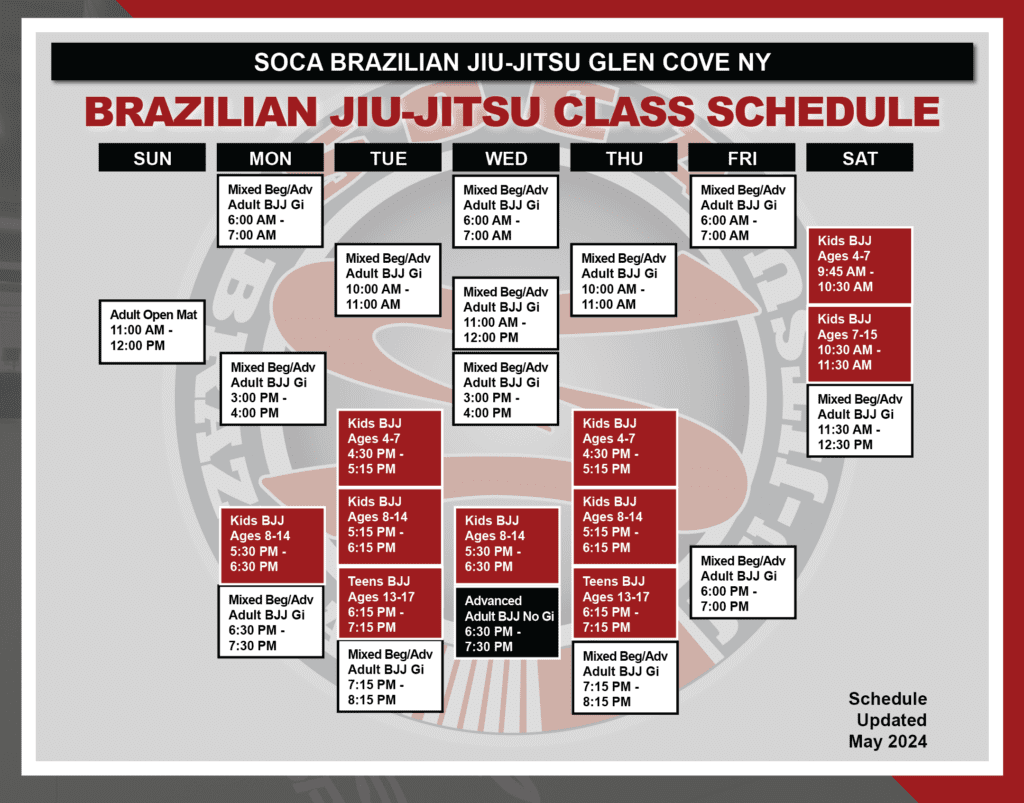
    For the Spring and Summer months, we will have our 4-7 yr old Kids group on Tuesdays, Thursdays, and Saturdays. We will not have 4-7 yr old Kids classes on Mondays & Wednesdays.

    Adults:
    Our early morning Adult BJJ classes are now Monday, Wednesday, and Friday.

    Check our Schedule Page for an updated Schedule.

    Soca Brazilian Jiu Jitsu Glen Cove Schedule - updated May 2024
  • New Adult BJJ Classes

    We are expanding on our adult Brazilian jiu jitsu schedule by adding an additional daytime class on Wednesday at 11am, and 2 early morning classes at 6:30am Wednesday/Friday.

    Visit our schedule page for our up to date class schedule.
    Soca BJJ Glen Cove Class Schedule